

Sure, AI is super helpful. But it’s draining Nature’s resources to get you that answer.
AI makes it so easy to ask anything. It’s a powerful, ubiquitous tool that helps us be more efficient, and in some cases, completes tasks better than we can. We get it: having answers at your fingertips within seconds is a heady feeling. Your blinking cursor is eager – practically begging – to help you.
AI is undeniably useful. But what is the price of this power and efficiency?
On the surface, AI feels harmless. After all, searching on the internet doesn’t require a credit card or any significant amount of skill. It’s all in the conceptual, nebulous cloud, right? But the truth is: everything has a carbon footprint…and AI’s footprint is gargantuan.
A carbon footprint is the total amount of greenhouse gas emissions an activity releases into the environment. These gases – mainly carbon dioxide – trap heat in the Earth’s atmosphere which fuels climate change over time. Anything that requires power – from driving a car to the foods we eat to the photos and emails we send – has a carbon footprint.
The Hidden Water Footprint of AI
Most AI implementations, including those operated by cloud service providers, are housed in data centers. These massive temperature-controlled warehouses hold servers, data storage drives, and network equipment, and rely on water to keep equipment cool.
Data centers have existed since the 1940s. But the rapid rise of data center construction over the last decade has disrupted local ecosystems and created an acute strain on municipal water supplies (especially in water-scarce regions like Arizona and Nevada). It’s estimated that two liters of water are required for each kilowatt hour of energy consumed by a data center. That’s a lot of water, considering that data centers suck up gigawatts of power at a time.


According to one estimate, global AI-related infrastructure may soon require over six times the water requirements of Denmark and its 6-million inhabitants. This is problematic, especially considering that nearly 2 billion people do not have access to clean water. The technology that powers AI, therefore, adds stress to an already worrying global water crisis.
Circular Water Management Strategies Can Lessen AI’s Impact on the Environment
Innovative water solutions are essential to ensuring that our dependence on AI doesn’t futher exacerbate our global water crisis. Circular water management strategies have the potential to reduce AI’s water consumption by up to 75%.
According to the World Economic Forum: “Solutions can range from water optimization, such as advanced liquid and closed-loop cooling solutions in data centres and replenishment, offering the potential to address water scarcity and energy efficiency challenges. With Microsoft already deploying closed-loop liquid cooling, Carrier investing in direct-to-chip cooling technology, and Ecolab’s recent launch of a cooling monitoring solution for direct-to-chip cooling, the momentum behind advanced liquid cooling solutions is clearly accelerating.”

Thinking Beyond AI’s Water Needs
Some AI data centers are also thinking beyond the water needs of their equipment. In addition to deploying strategies for water optimization, companies like Microsoft and Amazon Web Services (AWS) are ramping up water replenishment programs that seek to restore depleted watersheds in water-stressed areas.
Companies like Indra Water and Kilimo are on the cutting edge of new innovations that are helping whole industries scale up sustainably. Indra Water is currently leading the way in waste water management, with new technology that succesfully reclaims 95% of wastewater with a 74% emissions reduction from traditional treatment methods.
Kilimo leverages AI to help farmers optimize irrigation strategies. By analyzing weather, soil, and crop needs, Kilimo helps farmers irrigate more precisely. This provides relief to water sources, builds back critical local ecosystems, and improves soil health.
Polluting Hardware Production
But water consumption is only one piece of AI’s environmental toll. There’s also an environmental implication to producing the electronics and microchips required to power AI. Obtaining raw materials like lithium, cobalt, and other rare earth elements can involve dirty mining procedures and toxic chemicals. This extraction process can lead to habitat destruction, water pollution, and soil degradation.

And when those electronics are eventually discarded, that waste is difficult to recycle and likely to contain hazardous substances, like mercury and lead, that can lead to soil and water contamination. More stringent waste laws and ethical disposal practices are necessary to reduce the negative environmental effects of e-waste.
The Vampiric Energy Suck of Data Centers
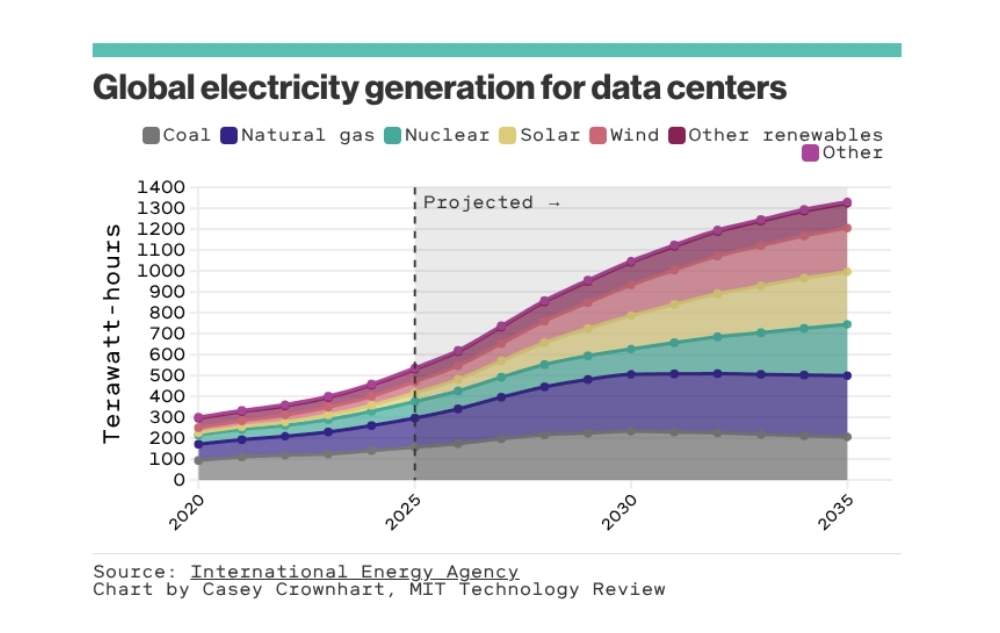
The amount of electricity required to build, train, and fuel the computational power of generative AI models with billions of parameters creates pressure on existing electrical grids and contributes to the overall carbon emissions of the technology. Training an AI model takes a massive amount of energy, as the program continually runs for weeks and months at a time until it’s built. Even after being trained, the AI program is still using energy to improve performance and source answers for billions of user queries.
Noman Bashir, a fellow with the MIT Climate and Sustainability Consortium, states: “The demand for new data centers cannot be met in a sustainable way. The pace at which companies are building new data centers means the bulk of the electricity to power them must come from fossil fuel-based power plants.”
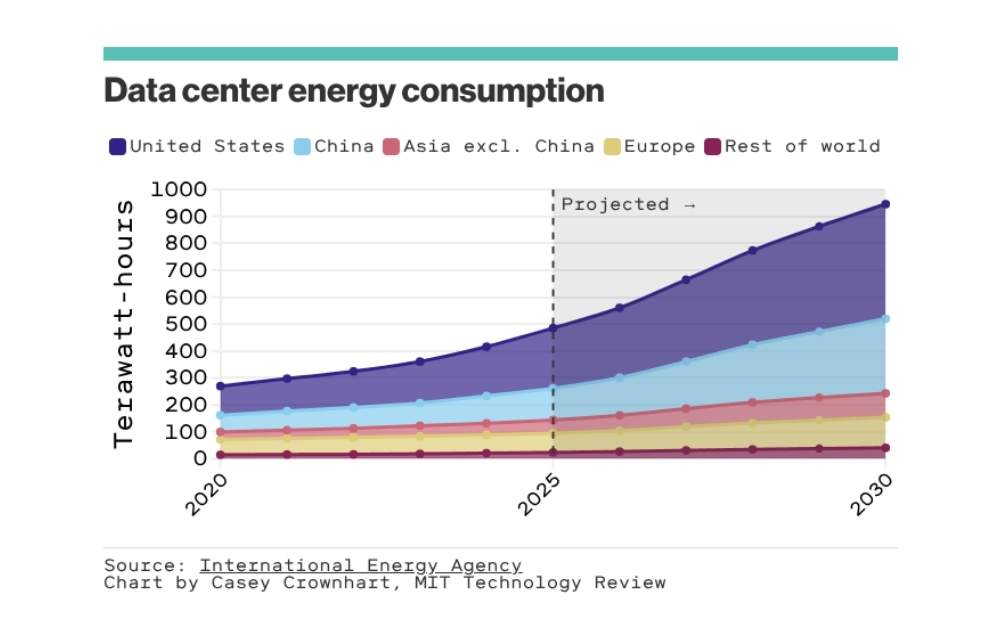
As MIT News reports: “Scientists have estimated that the power requirements of data centers in North America increased from 2,688 megawatts at the end of 2022 to 5,341 megawatts at the end of 2023, partly driven by the demands of generative AI. Globally, the electricity consumption of data centers rose to 460 terawatt-hours in 2022. This would have made data centers the 11th largest electricity consumer in the world, between the nations of Saudi Arabia (371 terawatt-hours) and France (463 terawatt-hours), according to the Organization for Economic Co-operation and Development. By 2026, the electricity consumption of data centers is expected to approach 1,050 terawatt-hours (which would bump data centers up to fifth place on the global list, between Japan and Russia).”
Learn more about the balance between AI and its energy demands with these four charts from MIT Technology Review.
Energy Infrastructure Must Scale Up to Prevent Demand from Outstripping Supply
Energy infrastructure is racing to keep up with AI’s demands by expanding grid capacity. AI is expected to account for up to 19% of data power demand by 2028. Goldman Sachs predicts that power demands will increase by up to 160% by 2030.
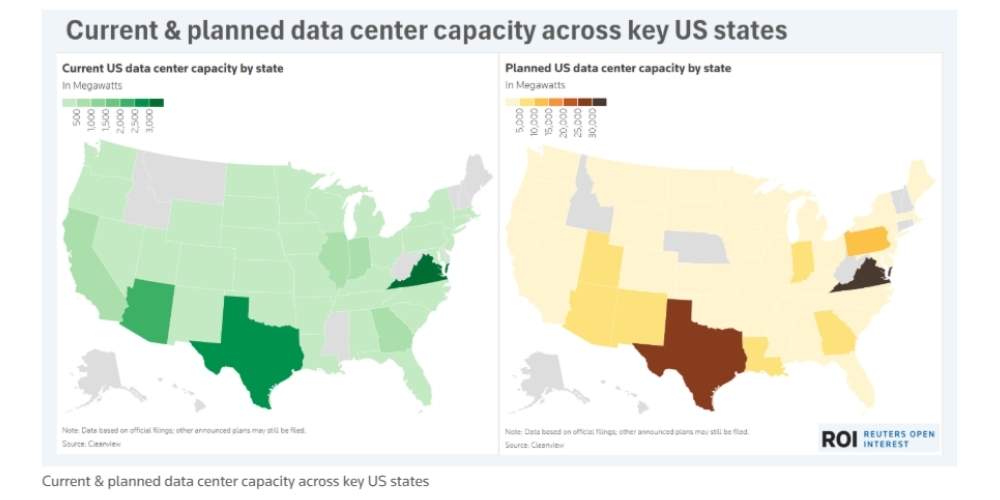
Source: Charting the Data Center Development Roadmap in Key US States – Reuters
It’s important to note that our current electrical model is structured so that electricity costs are shared by all users. As electric utilities are scrambling to build new transmission lines and power plants, that cost is rolling downhill to residential consumers, too.
Reuters reports: “Among the top 15 states for planned new data center capacity, electricity prices for residential customers have climbed by an average of 16% since the start of 2024, according to data from the U.S. Energy Information Administration. That price gain compares to a 10% rise in national residential electricity prices over the same period and indicates that hefty data center capacity pipelines may come with a side of local rate inflation.”
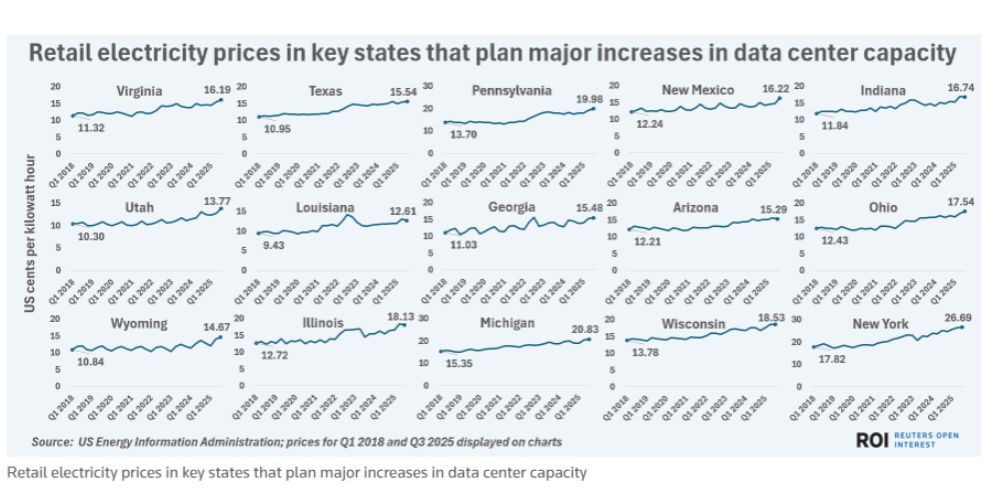
Source: Charting the Data Center Development Roadmap in Key US States – Reuters
There is some movement for data centers to shoulder more of the electrical costs, especially in areas where infrastructure is needed to add capacity. Resistance from local communities has led to the stalling of some data center proposals, and at the very least, has made corporations like Microsoft, Anthropic, and others make concessions to keep projects moving.
According to Consumer Reports, “Microsoft outlined a broad plan, pledging to cover its own electricity costs, reduce water use, create local jobs, and avoid seeking tax breaks. Anthropic, the company behind Claude AI, made its own promise to cover electricity price increases related to its data center development…Among other measures, companies agreed to ‘build, bring, or buy’ the power needed for their data centers and to pay for upgrades to electric grid infrastructure related to their facilities.”
All that being said: AI is – ironically – well equipped to help solve environmental issues.
AI has the capacity to synthesize data faster to help us tackle environmental and humanitarian emergencies across the globe. One of the biggest benefits of AI technology is that it can identify anomalies and similarities in data patterns, and use that data along with historical learnings to predict future outcomes. When used to monitor our planet, AI can help governments, businesses, and individuals make more informed climate decisions.
UNEP, for example, uses AI to detect and measure methane emissions from oil and gas installations. Scientists use AI to forecast solar and wind energy outputs, and to optimize temperature control in buildings. AI even helps forest rangers detect the early markers of wildfires with the help of solar-powered gas sensors. These advancements allow humans to react more immediately to changing and extreme weather conditions, and to synthesize data more effectively to combat climate change.
Such technological advances give us hope that AI could be a key tool in solving the climate crisis, restoring nature and biodiversity, and mitigating our waste and pollution problem.
Creating emissions guardrails and AI best practices are essential for our future.
It seems unlikely that we will go back to a world without AI. This is why it’s essential for governments, businesses, and communities to strive towards more ethical, environmentally-friendly AI practices. Greater environmental transparency and accountability is essential to ensuring that AI is used responsibly.
The UNEP recommends five ways the world could lessen AI’s toll on the planet:
-
- Countries can create standardized procedures to globally measure AI’s environmental impact.
- Governments can establish regulations that require companies to disclose the environmental impact of their AI-based products and services.
- Tech companies can reduce AI energy demands by making algorithms more efficient, and recycling water and electronic components where possible.
- Countries can incentivize companies to make their data centers more environmentally friendly through renewable energy and offsetting carbon emissions.
- Countries can modify their current environmental regulations to include AI-related policies.
In the meantime, we should be mindful of how we use AI, and understand its environmental consequences. By using AI with purpose and thoughtfulness, we can harness AI’s power for good, and drive a more sustainable future forward.
Additional Resources about AI and Its Environmental Implications:
- The Carbon Footprint of AI – Climate Impact Partners
- These Four Charts Sum Up the State of AI and Energy – MIT Technology Review
- The Climate and Sustainability Implications of Generative AI – MIT
- “Roadmap” Shows the Environmental Impact of AI Data Center Boom – Cornell Chronicle
- Energy and AI – IEA.org
- The Green Dilemma: Can AI Fulfil Its Potential Without Harming the Environment? – Earth.org
- Data centres use vast amounts of water – here’s how we advance water circularity – World Economic Forum
- Charting the Data Center Development Roadmap in Key US States – Reuters
- AI Data Centers: Big Tech’s Impact on Electric Bills, Water, and More – Consumer Reports
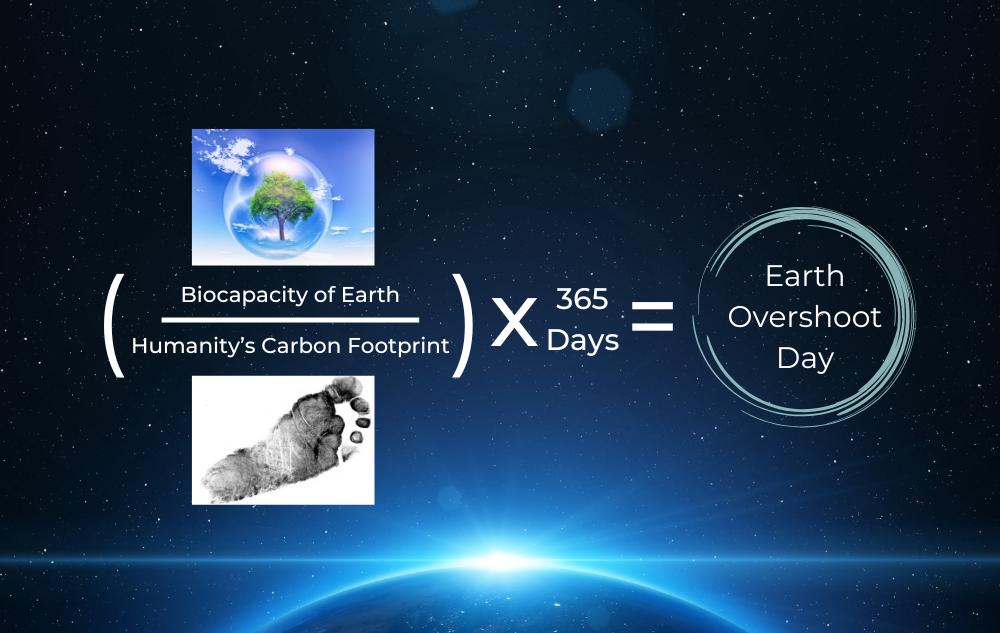
AI’s energy requirements exacerbate existing demands for Earth’s natural resources.
Earth Overshoot Day is an estimation of the day in which humans exceed their annual ecological budget. Each year, this date arrives earlier and earlier. It’s not too late to #MoveTheDate. Learn more about Earth Overshoot Day and the ecological deficit of the United States.
Discover More
One Planet Life Insights draw from a vast array of data gathered from the most reputable sources in the world. We curate and compile this rich information into interactive, easy-to-navigate insight maps to help you better understand your community and the world around us.