
Artificial intelligence is driving an unprecedented expansion of data centers across America.
Increasingly, that growth is moving into rural communities, raising important questions about energy, water, the environment, and who ultimately benefits.
Data centers exist in every state, yet until recently, most of us barely noticed them. So why have they suddenly become such a major topic of conversation? AI and other new digital technologies require an enormous amount of computing power. The sudden need to meet that demand is fueling a historic wave of data center development across the United States.
Up until recently, data centers in the United States have been concentrated in urban and suburban areas. However, that pattern is changing. An estimated 67% of planned data centers are now targeting rural areas, especially in southern and Midwest regions.
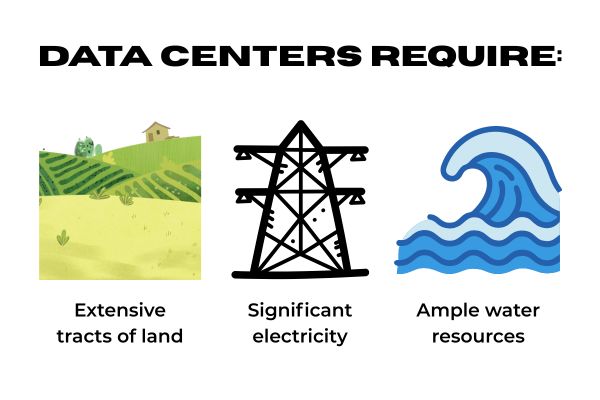
Several factors are driving this shift in data center construction. Building massive centers requires large tracts of land, substantial electricity, and, depending on their cooling systems, significant water resources.
Traditional data center hubs, such as the facilities in Loudoun County, Northern Virginia, are experiencing severe power capacity constraints and long delays connecting new facilities to the electrical grid.
As a result, developers are increasingly looking to rural communities where land is more available and new infrastructure may be easier to develop.
What Do Data Centers Mean for the People and Communities Nearby?
Depending on the size, design, infrastructure requirements, and proximity to homes and community spaces, the impact of a new data center could be significant.
Data centers create air pollution, as well as a substantial amount of noise and vibration that can be heard from outside the building. They gobble up electricity and require significant amounts of water to cool equipment, which often translates to higher electricity and water bills for the rest of the community. New data centers can also impact nearby property values, cause construction disruptions for years, and have a broader impact on local ecosystems and biodiversity.
All that being said, the construction of new data centers can also benefit a community. Data centers bring meaningful economic opportunities to rural communities, including increased tax revenue, construction jobs, local business activity, and investment in infrastructure.
New data centers may also create high-paying technical careers, although the number of permanent jobs is often relatively small compared with the scale of the investment. Some developers also commit to improving broadband infrastructure, supporting local schools, or investing directly in community programs.
Ultimately: Who Benefits, and Who Bears the Costs?
The arrival of a massive data center can fundamentally change a rural community. It can generate valuable tax revenue and economic opportunity, but it can also introduce long-term challenges involving infrastructure, natural resources, and quality of life. The critical question is whether the benefits are substantial enough, sustainable enough, and are shared broadly enough to justify the costs.
Before embarking on a data center project, residents and local government leaders should demand transparency and information so that they can make informed decisions. Communities need to look beyond what developers promise and truly understand what they are actually committing to deliver.
Some questions worth asking:
- How much electricity and water will the facility consume?
- Who will pay for new power lines, substations, roads, and other infrastructure?
- What environmental protections will be in place?
- How many permanent jobs will be created?
- What measurable, enforceable benefits will the community receive over time?
AI may be driving the next great infrastructure boom, but rural communities deserve a meaningful voice in determining how that transformation shapes their future.
At One Planet Life, We’re Taking a Closer Look
Our goal at One Planet Life is to better understand where data center growth is happening, and what it could mean for local communities and the environment. We believe understanding the impact of data centers starts with understanding the scale of what is happening.
The numbers at the state level are staggering. Let’s examine how much electricity data centers use, how much additional capacity is under construction, and how much is being planned.
We recognize that these figures are estimates. Projects are continually being announced, revised, delayed, or canceled. Not every proposed facility will be built. Nevertheless, the numbers provide a revealing picture of the extraordinary scale of development being considered across the country.
Understanding the Scale of Electricity
When examining data center energy needs, we encounter two measurements: megawatts (MW) and gigawatts (GW).
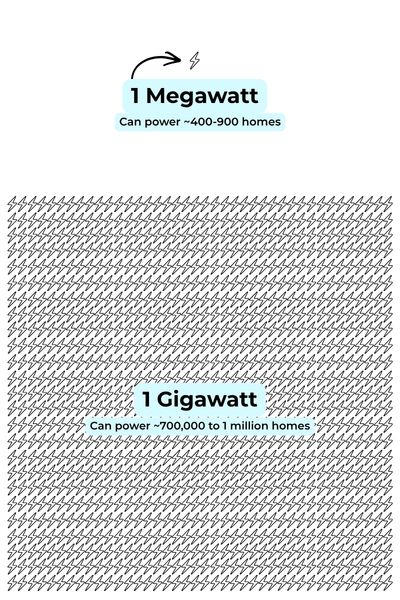
- 1 megawatt (MW) can provide enough electricity to power approximately 400–900 homes, depending on usage.
- 1 gigawatt (GW) equals 1,000 megawatts. That’s roughly the generating capacity of a large nuclear reactor and can represent enough electricity to power hundreds of thousands of homes.
These comparisons help put the enormous power requirements of data centers into perspective.
A single massive data center campus can require hundreds of megawatts, while some newly proposed developments estimate power needs to be multiple gigawatts.
To understand what is happening across the country, we organized all 50 states into three groups:
- Established data center states: States already using more than 1 GW of power for data centers, with significant additional expansion planned.
- Emerging high-growth states: States currently using less than 1 GW but with proposed development that could push demand well beyond that threshold.
- Lower-growth states: States with relatively modest data center power usage today and limited announced expansion.
What we discovered illustrates just how widespread this transformation could become.
Established Data Center States: Already Massive, and Growing
Today, 15 states have more than 1 GW of operational data center power capacity. Of those, 11 have significant data center development plans currently underway or in the pipeline. The other four states—Oregon, California, Tennessee, and Mississippi—have more than 1 GW of existing data center capacity but have comparatively limited expansion plans.
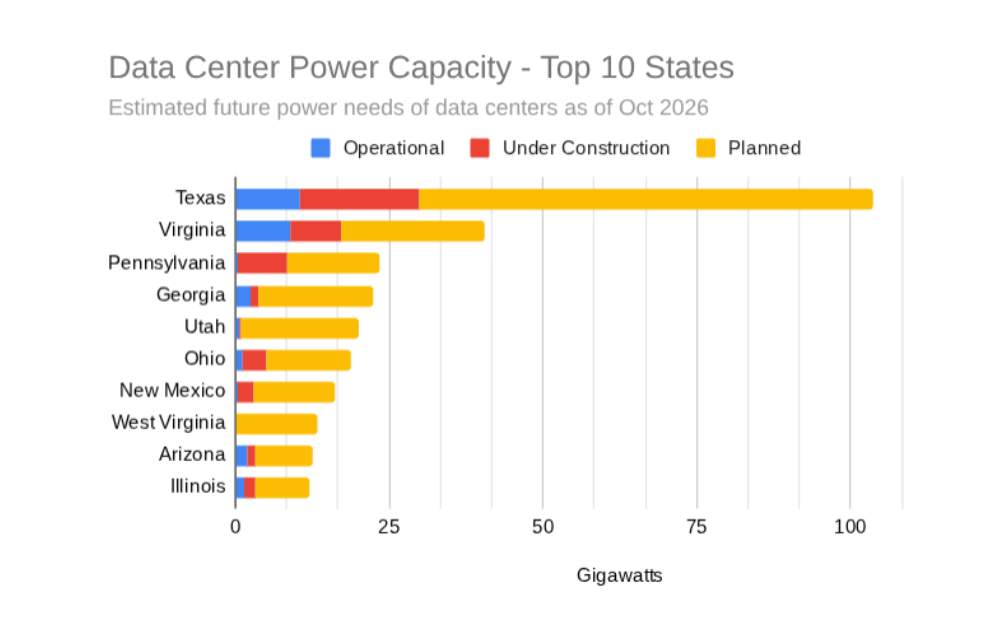
According to US Data Center Maps, Texas leads the country in data center power usage at approximately 10.5 GW per year. Based on current construction projects and additional sites planned, Texas could increase power usage by an estimated 93.1 GW. Virginia follows with approximately 9 GW usage, and a possible 31.6 GW of new data center capacity underway.
Source: US Data Center Map
When we combine existing facilities with those under construction and proposed developments, the potential total reaches an extraordinary 447 GW. That is an enormous increase.
Of course, not all proposed projects will become reality. Some may be scaled back, delayed, or canceled. But even if only a portion moves forward, the implications for electricity infrastructure, natural resources, and surrounding communities are substantial.
Emerging High-Growth States: The Next Wave
Twenty-four states are included in the emerging high-growth states list. These states currently have less than 1 GW of data center capacity, but have major expansion plans in the pipeline. It is highly likely that data centers in many of these states could move from having a relatively modest presence to becoming a significant part of the landscape and local economy.
Some notable states from the list include:
- Pennsylvania. The state currently has approximately 328 MW of operational data center capacity. Yet its potential development pipeline could bring that figure to approximately 23 GW. That’s a remarkable transformation.
- Utah. Despite having less than 1 GW of operational capacity today, proposed projects could bring its total to approximately 20 GW.
- New Mexico and West Virginia. Both of these states stand out from the group of 24, as they each are considering plans that represent approximately 13 GW of potential capacity.
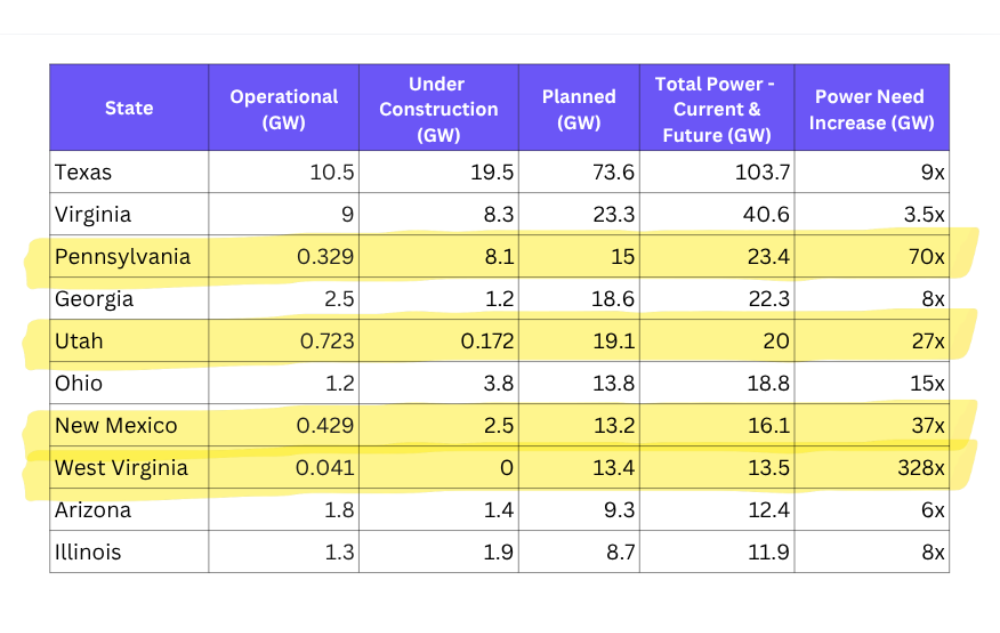
Source: US Data Center Map
These are not simply new buildings. Developments of this magnitude could require substantial new electricity generation, transmission lines, substations, water infrastructure, and roads. New data centers can also bring sizable revenue to the community, which could be reinvested in community development. For rural areas, the implications can be profound.
What happens when a relatively small community becomes home to an industrial-scale computing facility? How will local utilities accommodate the demand? What happens to water availability, land use, and the surrounding environment? And perhaps most importantly, how can communities ensure they benefit from the transformation rather than simply absorbing its costs?
Lower-Growth States: A Different Picture
The remaining 11 states have relatively modest data center capacity today and limited announced expansion. Based on the projects identified in our analysis, none are expected to reach 1 GW of total capacity.
That does not mean these states will remain unaffected by the AI infrastructure boom. Development plans can change quickly, and new opportunities may emerge as power availability, technology, and economic conditions evolve. But for now, they represent a very different level of data center activity.
The Big Picture: 39 States Face Significant Data Center Growth
When we combine the first two groups, the scale of this transformation becomes clear. Thirty-nine states—78% of the country—already have significant data center operations and/or are preparing for expansive new developments. The construction of data centers in America is already a national issue with deeply local consequences.
The scale of proposed developments raises important questions about where electricity will come from, how much new infrastructure will be required, how natural resources will be protected, and how communities will participate in decisions that could shape their futures for decades.
Perplexity Can Help You Understand How Your State Stacks Up
At One Planet Life, we care deeply about the intersection of people, communities, and the environment. The rapid expansion of data centers touches all three.
We believe the first step toward making informed decisions is understanding what is happening, where it is happening, and what questions communities should be asking.
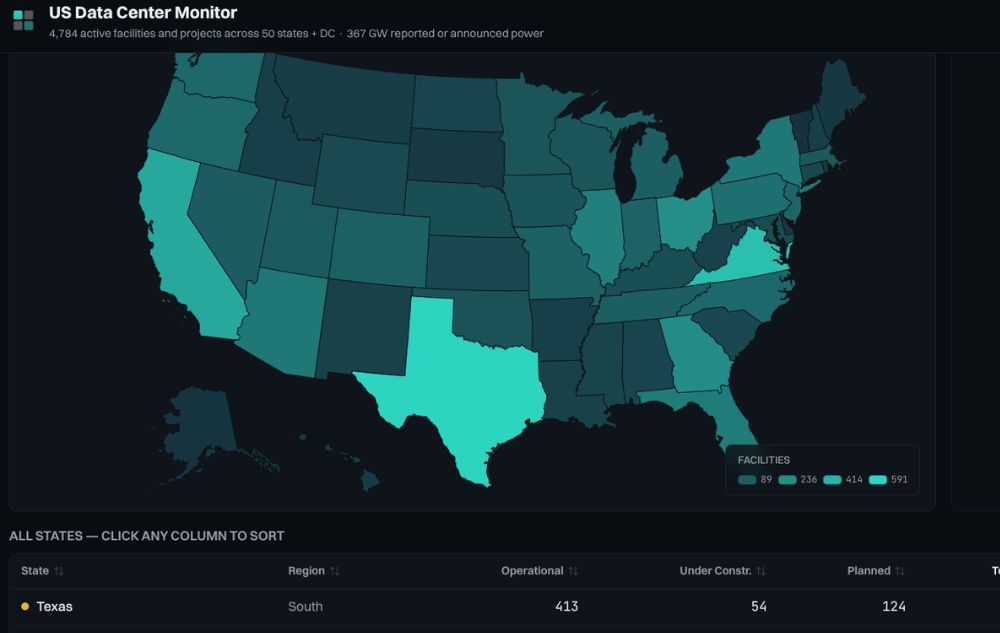
We discovered Perplexity, a tool that allows users to explore current data center capacity, facilities under construction, and planned development by state. It’s a really helpful way to understand what is happening in your state. Check it out here!
This Is Just the Beginning
In the coming months, we’ll take a closer look at individual states and communities, examining the potential environmental, economic, and quality-of-life impacts of this extraordinary infrastructure expansion.
Our goal is not simply to understand how big the data center boom can become. It is to understand what that growth means for the people and places affected by it.
AI is transforming our digital world. We need to make sure we understand how it is transforming our physical world, too.
We invite you to explore Perplexity’s map, learn about what’s happening in your state, and join us as we continue investigating.
Thank you for being part of the One Planet Life journey.
Other Articles You May Be Interested In:
- One Planet Life – AI’s Shocking Toll on the Environment
- One Planet Life – Book Review: Nexus: A Brief History of Information Networks from the Stone Age to AI
- BBC – A humming annoyance or jobs boom? Life next to 199 data centres
- Loudoun Climate Project – The Dark Side of Data Centers: Impacts of Loudoun’s Data Center Industry
- The Harvard Gazette – Why are Communities Pushing Back Against Data Centers?

Written by Lorie Buckingham
OPL Founder and Wayfinder
“Over the years, I was struck by how our lifestyles cause stress both on us and the planet. This led me to explore and learn about sustainability and wellness. With a deeper understanding, I began to make tangible changes in my life. One Planet Life LLC was founded to connect with others on this journey. I hope that together we can make a significant difference for people and the planet.”