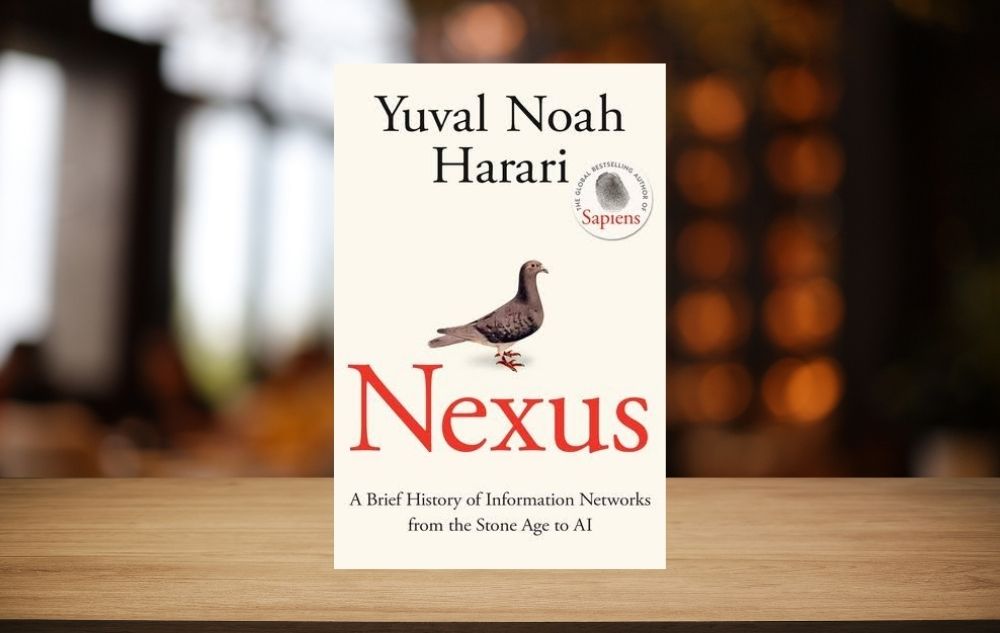
Nexus: A Brief History of Information Networks from the Stone Age to AI
Written by Yuval Noah Harari
OPL BOOK SUMMARY: Yuval Noah Harari takes us on a fascinating journey through the human networks that connect us, anchored in our shared history. He begins with a fundamental question: What is information, and what does it actually do?
Thinking about Information Differently
Harari introduces different ways to think about information: 1) the naive view, where information is seen as an objective reflection of reality, 2) the populist view, in which information is a weapon used by elites to manipulate others, and 3) the historical view, which sees information as a tool for connecting people, balancing reality with cooperation.
The naive view sees information primarily as an attempt to represent reality. While those who hold this view recognize that some information is inaccurate, they tend to dismiss it as either “misinformation – an honest mistake” or “disinformation – a deliberate lie.” They believe that more information will ultimately solve the problem. The assumption is that the more we know, the more truthful our understanding of the world will become. But is that really true? Or does human nature lead us to use information in very different ways?
To illustrate the naive view, Harari contrasts astronomy, which is considered reliable information about the universe and stars, with astrology, While astrology is generally regarded as misinformation or disinformation it continues to have enormous influence on humans. As Harari writes: “Today millions of people still check their star signs before making the most important decisions of their lives…. As of 2021, the global astrology market was valued at $12.8 billion.”
Harari challenges us to consider that information does far more than represent truth. Information creates new realities and connects people, whether or not it is true.
“While information always connects, some types of information – from scientific books to political speeches – may strive to connect people by accurately representing certain aspects of reality. But this requires a special effort, which most information does not make. That is why the naive view that creating more powerful information technology will necessarily result in a more truthful understanding of the world. If no additional steps are taken to tilt the balance in favor of truth, an increase in the amount and speed of information is likely to swamp the relatively rare and expensive truthful accounts with much more common and cheap types of information.”
This really hits home today. It has become incredibly easy to create and distribute information with little thought or accountability. It doesn’t have to be accurate, carefully considered, or even true.
Information as a Tool for Connection
Harari explains that one of the primary reasons homo sapiens have been so successful is our ability to cooperate flexibly in large numbers. Information networks have made that cooperation possible, but the journey has been anything but smooth. Throughout history, documents, literacy, and control over information have become powerful tools for shaping societies and determining who holds power.
One of the most disturbing examples is the role of the printing press in fueling the European witch hunts, tragedies that ultimately claimed between 40,000 and 50,000 lives.
For much of the Middle Ages, European societies were not particularly concerned about witchcraft. Even the Catholic Church did not view it as a major threat, often dismissing it as an “unchristian illusion.” So what went so terribly wrong?
The printing revolution brought extraordinary benefits, allowing information to spread more freely and reach far more people. But it also made it possible for dangerous ideas to spread on an unprecedented scale.
Around this time, a Dominican friar named Heinrich Kramer launched a witch hunt in the Alpine region of Europe. His behavior was so extreme that local church authorities expelled him. Rather than abandoning his crusade, Kramer turned to the printing press.
He wrote and published The Hammer of the Witches, essentially a do-it-yourself guide to identifying, prosecuting, and killing supposed witches. The book became one of the biggest sellers of early modern Europe, feeding people’s fears and fascination with dark practices.
What was essentially a fantasy helped fuel the horrific witch hunts of the 1500s and 1600s. Only gradually did these persecutions decline as attitudes and understanding began to change.
It is frightening to consider how long societies can continue acting on falsehoods, even when the human consequences are devastating.
As Harari points out, this example “demonstrates that releasing barriers to the flow of information doesn’t necessarily lead to the discovery and spread of truth.”
From there, Harari takes us through the evolution of information networks right up to the present day, exploring how they have shaped both democracies and totalitarian societies. He helps us understand the extraordinary benefits of information technology alongside the very real risks of how it can be used to influence, manipulate, and control.
Artificial Intelligence’s Effect on Information
Toward the end of the book, Harari turns to the choices humanity faces as artificial intelligence transforms our information networks. He highlights the importance of international cooperation, including forging and maintaining agreements on AI, and the responsibility we all share in shaping what comes next.
The choices we make about information and AI will have profound consequences for our future. Those choices require us to think critically about what we believe, what we share, and how we use these powerful technologies.
Once again, Yuval Noah Harari delivers a deeply thoughtful and thought-provoking read. He opens our eyes to the extraordinary moment we are living through while grounding our understanding in the lessons of our shared history. Perhaps the most important takeaway is that more information does not necessarily make us wiser or bring us closer to the truth. That requires something more from each of us.
Available used at BetterWorldBooks.

Find your next great read.
One Planet Life has curated a list of recommended books to guide and inspire you. Consider a new perspective, look back at history, try something new with the help of a practical guide, or experience the wonders of a new world!